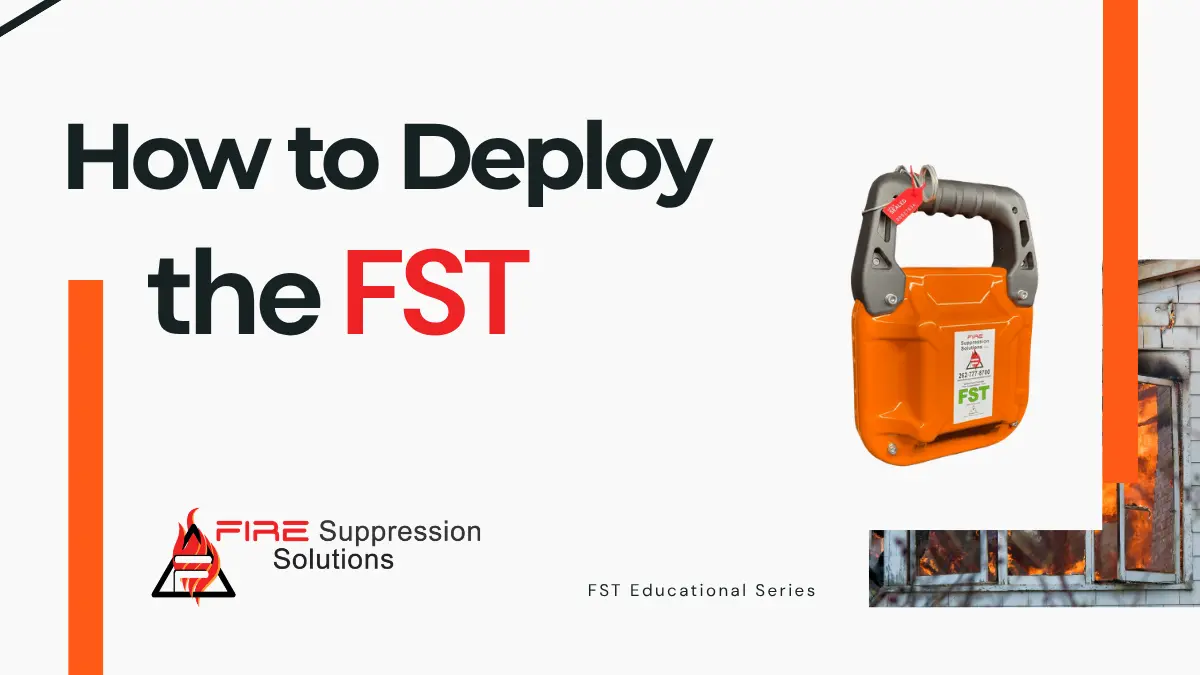
The Fire Suppression Tool (FST) uses a specific two-pin activation and deployment sequence. After assessing the fire and identifying an appropriate deployment location, the user removes the R Pin, pulls the Igniter Pin and immediately deploys the FST near the seat of the fire. Pulling the Igniter Pin starts an approximately 8-second countdown that cannot be stopped.
After deployment, the affected space should remain as contained as possible while the FST releases its fire suppression aerosol.
Users should be trained and familiar with the FST before an emergency occurs and should review the complete operating instructions before use.
Before You Deploy the Fire Suppression Tool
Fire conditions can change rapidly, so deployment begins with assessing the situation rather than immediately activating the device.
Before using the FST:
- Activate 9-1-1 as soon as a fire is detected.
- Assess the scene and determine whether FST deployment is appropriate.
- Identify the safest appropriate deployment location near the seat of the fire.
- Consider whether the affected area is sufficiently contained for the FST’s total-flood aerosol technology to work effectively.
- Make sure people in the immediate deployment area are clear of where the device will land.
- Never enter or approach a burning structure simply to deploy the FST.
The FST is designed to work most effectively when the fire is within a contained area and the device can be deployed near the seat of the fire.
How to Activate and Deploy the Fire Suppression Tool
The current Fire Suppression Tool v4 uses two pins that must be removed in the correct order.
1. Locate & Assess
Locate the FST and evaluate the fire scene.
Identify the safest appropriate place to deploy the device near the seat of the fire. The FST performs best when the affected area is contained and the aerosol can remain within the space.
Do not activate the device until the decision to deploy has been made and you are prepared to complete the activation sequence.
2. Pull the R Pin
Firmly grasp the R Pin and pull it straight out of the device.
Removing the R Pin unlocks the Igniter Pin so that the FST can be activated.
The R Pin should remain in place during normal storage and should not be removed until the FST is actually needed for deployment.
3. Pull the Igniter Pin
After removing the R Pin, firmly grasp the Igniter Pin and pull it straight up and completely out of the device.
This activates the FST.
Once the Igniter Pin has been removed:
- the approximately 8-second countdown begins
- the LED light on the handle begins blinking
- the activation sequence cannot be stopped or reset
Do not remove the Igniter Pin unless you are ready to immediately deploy the device.
4. Countdown & Deploy
Once the Igniter Pin has been pulled, do not continue holding the FST.
Immediately deploy the device into the affected area near the seat of the fire.
When possible, deploy the FST toward level ground and keep the intended landing area clear of other people.
After the approximately 8-second countdown, the FST begins releasing its aerosol.
5. Contain the Space
After the FST has been deployed, make every reasonable effort to keep the room or affected area closed or sealed.
Do not immediately ventilate the space.
The FST relies on the aerosol remaining within the affected area at an effective concentration while it acts on the fire.
The device releases aerosol for approximately 35 seconds.
For a deeper explanation of why containment matters and how the aerosol suppresses fire without depleting oxygen, see how the Fire Suppression Tool works.
What Happens After You Pull the Igniter Pin?
Pulling the Igniter Pin is the point at which FST activation becomes irreversible.
Once it is removed, the approximately 8-second countdown begins and cannot be stopped.
The LED on the FST handle begins blinking during the countdown. The device must then be deployed immediately into the intended area.
After activation:
- Do not hold onto the device.
- Do not attempt to stop the activation process.
- Do not try to reinstall the Igniter Pin.
- Do not attempt to retrieve an activated FST.
These instructions are important because the device is already committed to aerosol release once the Igniter Pin has been removed.
Where Should the Fire Suppression Tool Be Deployed?
The FST should be deployed into an appropriate contained space at or near the seat of the fire, while maintaining a safe deployment position.
Containment matters because the FST is a total-flood suppression tool. Its aerosol disperses throughout the affected space rather than being continuously aimed at one portion of the fire.
The FST performs best when the fire is in an enclosed or contained area and the device can be deployed near the seat of the fire.
When possible:
- identify the deployment location before activating the device
- aim for a location near the seat of the fire
- place the device on or toward level ground
- keep the intended landing area clear of other people
- maintain the enclosure of the affected space following deployment
Users should never enter a burning structure simply to achieve a preferred FST placement.
Why Should the Space Remain Contained After Deployment?
The FST’s fire suppression aerosol needs to remain within the affected area long enough to act on the fire.
Opening the space or introducing ventilation too early can reduce the concentration of aerosol available for suppression.
After deployment, make every reasonable effort to keep the affected room closed or sealed and do not ventilate while the FST is initially operating.
The relationship between aerosol concentration, enclosure and fire suppression is covered in more detail in our article How Does the Fire Suppression Tool Work?
What Should Happen After the FST Has Discharged?
Do not enter the affected room or space while the FST is still discharging.
Allow the device to complete its discharge and give the aerosol adequate time to act on the fire before anyone enters the affected space.
Following deployment, the space should be ventilated when it is appropriate and safe to do so.
Firefighters or other qualified personnel should also check the area for remaining hotspots and use water or another appropriate extinguishing agent as necessary.
Personnel entering a fire-affected space should follow appropriate protective procedures because smoke, combustion byproducts and residue from the materials involved in the fire may still be present even after the FST has been deployed.
For responder-specific operational considerations, see Fire Suppression Tool for First Responders.
Important Fire Suppression Tool Deployment Reminders
Before an FST is ever needed in an emergency, users should understand several key points:
- Activate 9-1-1 as soon as a fire is detected.
- The FST should only be used by people who are trained and familiar with its operation.
- Keep the R Pin in place until the decision to deploy has been made.
- Pull the R Pin before pulling the Igniter Pin.
- Pulling the Igniter Pin begins an approximately 8-second activation countdown.
- Once the Igniter Pin is removed, activation cannot be stopped or reset.
- Do not continue holding an activated FST.
- Do not attempt to retrieve an activated device or reinstall the Igniter Pin.
- Deploy the device near the seat of the fire when it can be done safely.
- Keep the affected area contained while the aerosol is initially operating.
- Do not enter a burning structure simply to deploy the FST.
- Follow applicable training, emergency-response procedures and the operating instructions.
The Fire Suppression Tool is an additional method of fire suppression. It does not replace emergency response or required fire extinguishers.
Learn More About the Fire Suppression Tool
Understanding the deployment sequence before an emergency is an important part of preparing to use the FST correctly.
Continue with:
- How Does the Fire Suppression Tool Work?
- Fire Suppression Tool for First Responders
- Fire Suppression Tool vs. Fire Extinguisher
- View the Fire Suppression Tool