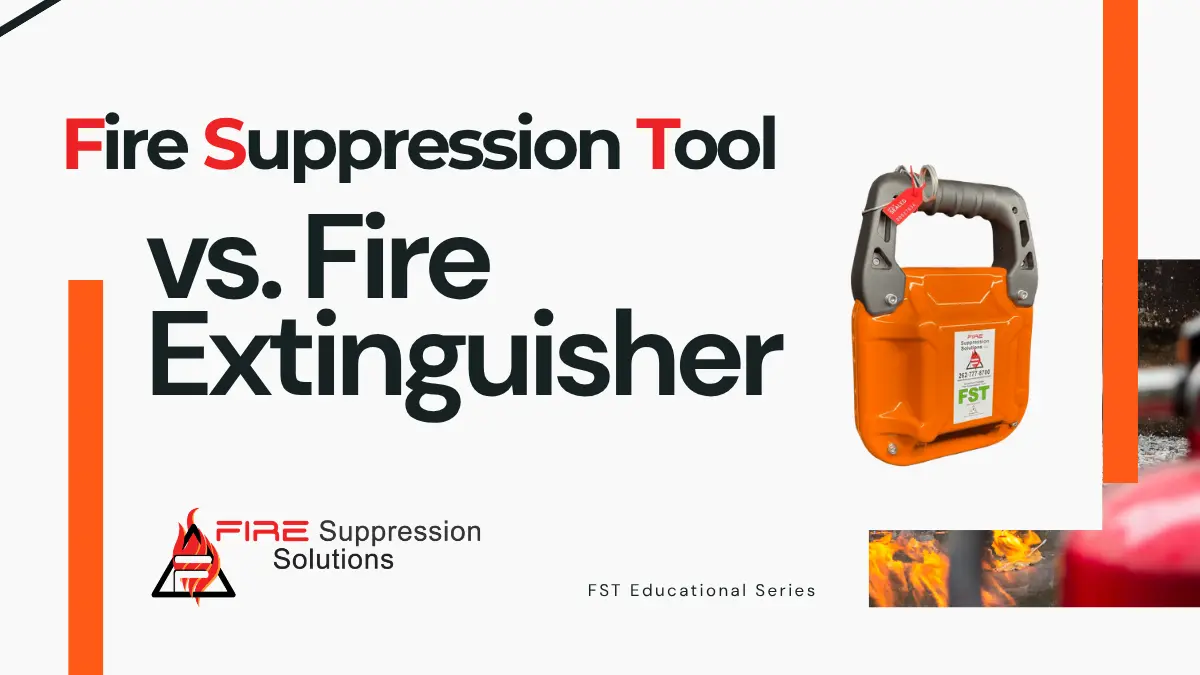
The Fire Suppression Tool (FST) and a portable fire extinguisher can both be used as part of a fire response, but they are different types of suppression equipment that operate in different ways.
A portable fire extinguisher requires the user to manually direct an extinguishing agent toward the fire. The FST is activated and deployed into an appropriately contained space, where its aerosol disperses throughout the area and acts on the conditions sustaining the fire.
Most importantly, the FST is not a portable fire extinguisher and is not intended to replace fire extinguishers required under NFPA 10.
For many organizations evaluating fire-response equipment, the better question is therefore not “Which one wins?” but “What role does each tool serve?”
What Is the Main Difference Between an FST and a Fire Extinguisher?
The biggest difference is how the suppression agent reaches and acts on the fire.
A conventional portable extinguisher is manually operated. The user positions themselves at an appropriate distance, maintains an escape route, aims the extinguisher toward the fire and discharges the extinguishing agent.
The Fire Suppression Tool operates differently.
Once activated, the FST is deployed into the affected area. It then releases an aerosol throughout the contained space for approximately 35 seconds.
Instead of requiring someone to continuously direct the agent toward visible flames, the FST uses a total-flood suppression approach. Its aerosol expands throughout the affected area, reduces heat and interrupts the chemical chain reaction that allows the fire to continue burning.
For a deeper explanation of that process, see How Does the Fire Suppression Tool Work?
Fire Suppression Tool vs. Fire Extinguisher at a Glance
| Fire Suppression Tool | Portable Fire Extinguisher | |
| Type of equipment | Portable fire suppression device | Portable fire extinguisher |
| Pressure | Non-pressurized | Conventional extinguishers are pressurized devices |
| Operation | Activated and deployed into the affected area | User manually aims and discharges the agent |
| User position during discharge | User does not continue holding the FST after activation and deployment | User remains with the extinguisher while applying the agent |
| Suppression approach | Aerosol disperses throughout an appropriately contained space | Extinguishing agent is directed toward the fire |
| Containment | Performs best in enclosed or contained spaces | Use depends on the extinguisher type, rating and fire conditions |
| Oxygen | Does not deplete oxygen | Depends on the extinguishing technology |
| FST coverage | Up to 5,300 cubic feet under appropriate conditions | Varies by extinguisher model and rating |
| FST discharge | Approximately 35 seconds | Varies by extinguisher |
| Fire classes | Designed for Class A, B, C and K fires | Depends on the extinguisher’s classification and rating |
| Replaces required extinguisher? | No | N/A |
The specific capabilities and operating instructions of portable fire extinguishers vary by model. Always use the classification, instructions and limitations provided for the extinguisher being used.
How Does Fire Suppression Tool Deployment Differ From Using an Extinguisher?
Using a portable fire extinguisher generally requires the operator to remain with the device while applying the extinguishing agent.
The operator must approach from an appropriate position, maintain a safe escape path, aim toward the base of the fire and manually discharge the agent.
FST deployment is fundamentally different. The FST v4 uses a two-pin activation sequence. Once the Igniter Pin is removed, an approximately 8-second countdown begins and cannot be stopped.
The device is then immediately deployed into the affected area near the seat of the fire. The user should not continue holding the FST once it has been activated.
The aerosol begins releasing after the countdown and expands throughout the contained space.
For the complete activation sequence and safety considerations, see How to Deploy the Fire Suppression Tool.
Does the Fire Suppression Tool Replace a Fire Extinguisher?
No. The Fire Suppression Tool is not classified as a portable fire extinguisher and is not intended to replace extinguishers required under NFPA 10.
That is an important distinction for businesses, public facilities, fire departments and other organizations evaluating the FST.
Adding an FST does not eliminate required portable fire-extinguisher equipment.
Instead, the FST provides an additional suppression capability that operates differently from a handheld extinguisher.
This means an organization may reasonably choose to incorporate both within its fire-readiness strategy, depending on applicable requirements, risks, training and the environments being protected.
Do You Need Both an FST and a Fire Extinguisher?
In any location where portable fire extinguishers are required, the FST should be viewed as supplemental equipment rather than a replacement.
Whether adding an FST is appropriate depends on the environment and the organization’s fire-response needs.
Questions worth considering include:
- What types of fire risks are present?
- Are there enclosed spaces where total-flood suppression could be useful?
- Who would be trained to deploy the FST?
- Where would the device be stored?
- How would FST deployment fit into existing emergency-response procedures?
- What extinguishers or other suppression equipment are already required or available?
The goal is not to accumulate as many fire products as possible. It is to build a response plan in which each tool has a clear purpose.
For first-responder organizations, read Fire Suppression Tool for First Responders for additional operational considerations.
Which Is Better: the FST or a Fire Extinguisher?
Neither tool is universally “better.” They solve the suppression problem in different ways.
A portable fire extinguisher allows the user to manually direct an agent toward a fire and can be appropriate for conditions matching that extinguisher’s rating and operating instructions.
The FST provides a different approach. It can be deployed into an appropriately contained area and allowed to release aerosol throughout the space without requiring the user to continuously remain near the fire during discharge.
The better option therefore depends on:
- the type and location of the fire
- the characteristics of the space
- available equipment
- user training
- applicable procedures and requirements
- whether continued manual application or contained-space suppression is more appropriate to the situation
In many preparedness plans, the answer may be both rather than either/or.
Does the FST Require You to Stay Near the Fire?
After the FST has been fully activated, the user does not remain holding the device while it discharges. Once the Igniter Pin is removed, the approximately 8-second countdown begins and the device must be deployed immediately.
The aerosol is then released within the affected area.
That differs from handheld extinguisher operation, where the user remains with the extinguisher while applying its agent toward the fire. This difference can reduce the amount of time the FST user must remain in the immediate vicinity while the suppression agent is being discharged.
It does not mean users should take additional risks to deploy the FST. No one should enter a burning structure simply to place the device.
How Does the Suppression Agent Differ?
The Fire Suppression Tool uses SFE powdered aerosol technology designed for total-flood fire suppression.
The FST aerosol is:
- non-toxic
- non-corrosive
- non-conductive
- 0% Ozone Depletion Potential
- 0% Global Warming Potential
It suppresses fire without depleting oxygen from the affected space.
Portable fire extinguishers can use different types of extinguishing agents depending on their design and fire classification. The appropriate extinguisher must therefore be selected and used according to its specific rating and instructions.
The FST is designed for Class A, B, C and K fires.
Why Does Enclosure Matter More for the FST?
The FST uses total-flood suppression, so the aerosol needs to remain within the affected area at an effective concentration.
That makes room containment an important part of FST performance.
Opening the space or introducing ventilation too early can allow aerosol to escape and reduce the concentration available for suppression.
A portable extinguisher applies its extinguishing agent directly toward the fire instead, so the suppression method is fundamentally different.
This is one reason the products should not be thought of as interchangeable.
Can the FST and a Fire Extinguisher Be Used as Part of the Same Response?
Yes. The FST is designed to complement established fire-response methods rather than replace them.
After FST deployment, qualified personnel must still evaluate the affected area for remaining fire or hotspots. Water or another appropriate extinguishing agent may still be needed.
Likewise, use of the FST does not replace:
- calling 9-1-1 when a fire is detected
- required fire extinguishers
- department or organizational procedures
- responder training
- post-fire evaluation and overhaul
The FST adds another suppression option to the response.
Choosing Fire-Response Equipment
Fire preparedness is not simply a question of choosing one fire suppression product over another.
The right equipment depends on the risks being addressed, the environment, applicable requirements and the people expected to use it.
The Fire Suppression Tool offers a portable, non-pressurized total-flood suppression option that works differently from a conventional handheld extinguisher. A portable fire extinguisher remains a separate and important piece of fire-response equipment, including wherever extinguishers are required.
Understanding the difference between the two makes it easier to determine where each belongs in a broader fire-readiness plan.
For complete FST specifications, applications, videos and purchasing information, visit the Fire Suppression Tool product page.