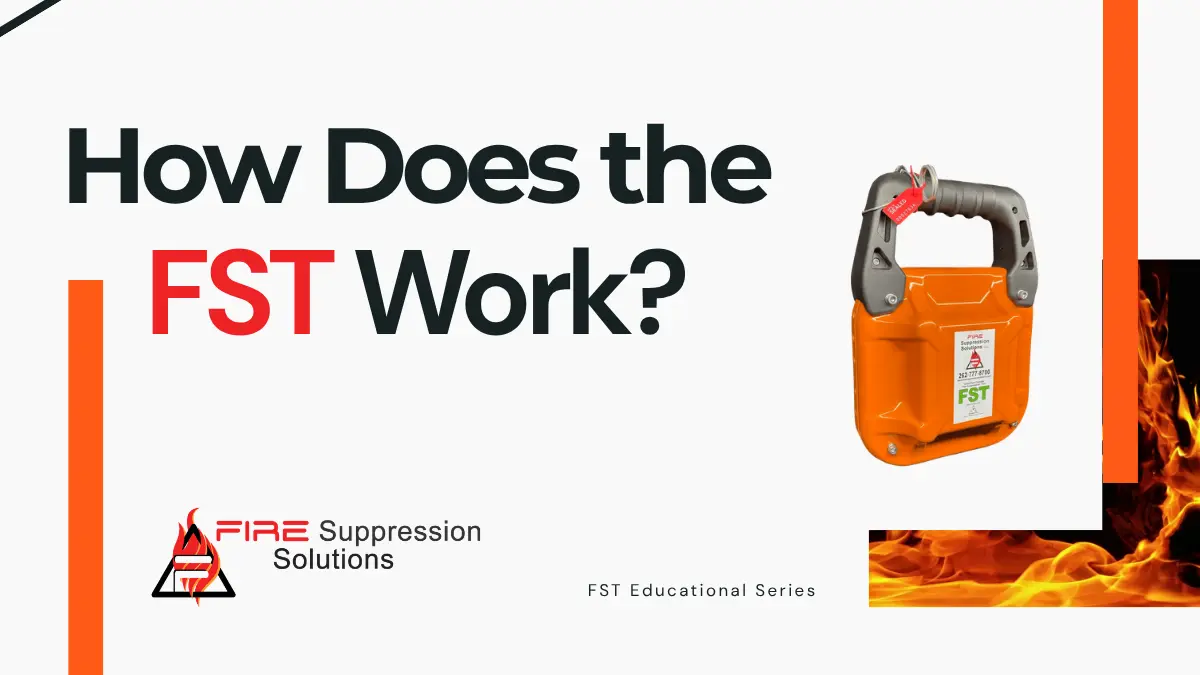
The Fire Suppression Tool (FST) is a portable, non-pressurized fire suppression device that releases an aerosol into a contained space. Once activated, the aerosol expands throughout the affected area, reduces heat and interrupts the chemical chain reaction that allows a fire to continue burning, without depleting oxygen from the space.
Rather than requiring someone to continuously direct an extinguishing agent at the flames, the FST is designed to provide total-flood fire suppression within an appropriately contained area.
Here is what happens from activation through suppression.
What Happens When the Fire Suppression Tool Is Activated?
The FST uses a two-pin manual activation sequence connected to an electronic ignition system.
Once the device has been fully activated, an approximately 8-second countdown begins. The FST is then deployed into the affected area, where it releases its aerosol for approximately 35 seconds.
As the aerosol is discharged, it expands throughout the contained space.
One FST is designed to provide coverage of up to 5,300 cubic feet under appropriate conditions.
At a high level, the process looks like this:
- The FST is activated.
- An approximately 8-second countdown begins.
- The device is deployed into the affected area.
- The aerosol is released for approximately 35 seconds.
- The aerosol expands throughout the contained space.
- The aerosol reduces thermal activity and interrupts the chemical chain reaction that sustains the fire.
Check out our guide to deploying the Fire Suppression Tool.
How Does the FST Suppress a Fire?
To understand how the FST works, it helps to understand that a fire depends on more than visible flames.
For combustion to continue, the conditions sustaining the fire must remain in place. The FST’s aerosol acts on that process by reducing thermal activity and interrupting the chemical chain reaction that allows the fire to continue burning and spreading.
As the aerosol disperses throughout the contained space, it interacts with the fire rather than simply coating one visible area.
This is why the FST is considered a total-flood fire suppression tool. The aerosol is designed to spread throughout the affected space so it can act on the fire across that environment.
The FST can also significantly reduce heat. Under appropriate conditions, documented product performance includes temperature reductions of up to 1,000°F within 35 seconds.
Actual fire conditions vary, so the FST should be understood as a suppression tool rather than a guarantee that every fire will be completely extinguished.
How Does the FST Work Without Depleting Oxygen?
One of the most common questions about the Fire Suppression Tool is whether it works by removing oxygen from the room.
It does not.
The FST suppresses fire without depleting oxygen from the affected space.
Instead of relying on oxygen displacement, the aerosol interferes with the fire’s thermal activity and chemical chain reaction.
That distinction is important because the visible aerosol can resemble smoke when it is released. Its appearance does not mean the FST is filling the room with a gas intended to remove the available oxygen.
The aerosol is the fire suppression agent dispersing throughout the area.
Why Does the FST Work Best in a Contained Space?
Containment is an important part of how the Fire Suppression Tool works.
The FST is designed for total-flood fire suppression, meaning its aerosol needs to disperse through the affected space and remain at an effective concentration long enough to act on the fire.
For that reason, the FST performs best in enclosed or contained areas.
Ventilating the affected area too early can reduce the concentration of aerosol available for suppression, so the space should remain contained while the FST is initially operating.
One FST can provide coverage of up to 5,300 cubic feet under appropriate conditions, but room configuration and the degree of enclosure are important considerations.
This is also why the FST should not be thought of as simply a device that is thrown toward visible flames. The surrounding environment is part of how the suppression technology functions.
What Is the Aerosol Released by the Fire Suppression Tool?
The Fire Suppression Tool uses SFE powdered aerosol technology designed for total-flood fire suppression applications.
The FST aerosol is:
- Non-toxic
- Non-corrosive
- Non-conductive
- 0% Ozone Depletion Potential (ODP)
- 0% Global Warming Potential (GWP)
The technology is also listed on the U.S. Environmental Protection Agency’s Halon Alternatives SNAP list as Powdered Aerosol A.
When released, the condensed aerosol can have the appearance of smoke as it disperses throughout the space.
The fact that the aerosol itself is described as non-toxic does not eliminate normal fire-scene hazards. Smoke, combustion byproducts and residue from the materials involved in the fire may still be present. Appropriate fire-response precautions should always be followed before entering an affected area.
How Quickly Does the Fire Suppression Tool Work?
Once the FST has been fully activated, there is an approximately 8-second countdown before aerosol release begins.
The device then discharges the aerosol for approximately 35 seconds.
During this period, the aerosol expands through the contained area and begins acting on the conditions sustaining the fire.
The FST can also reduce temperatures significantly, with documented product performance of up to 1,000°F of temperature reduction within 35 seconds under appropriate conditions.
That combination of aerosol dispersion, fire suppression and heat reduction is designed to slow or stop the fire’s progression and help create more manageable conditions for the continued emergency response.
How Is This Different From a Fire Extinguisher?
The Fire Suppression Tool is a fire suppression device, not a portable fire extinguisher, and it is not intended to replace fire extinguishers required under NFPA 10.
The distinction matters because the two products operate differently.
A conventional handheld fire extinguisher generally requires the user to remain in position and direct an extinguishing agent toward the fire. The FST is deployed into an affected contained space, where its aerosol disperses throughout the area and acts on the processes sustaining the fire.
For a deeper look at how the two approaches differ, read Fire Suppression Tool vs. Fire Extinguisher.
Understanding the FST Before an Emergency
The Fire Suppression Tool is designed to provide an additional fire suppression option when its use is appropriate for the situation.
It does not replace emergency response. 9-1-1 should be activated as soon as a fire is detected.
Users should also be trained and familiar with the operation of the FST before an emergency occurs. First responders should use the device in accordance with their department’s procedures and applicable training.
Understanding what happens after activation, how the aerosol suppresses fire and why containment matters can help users better understand the role the FST is designed to play in a fire response.
For complete specifications, applications and purchasing information, visit the Fire Suppression Tool product page.
Continue Learning About the Fire Suppression Tool
- How to Deploy the Fire Suppression Tool
- Fire Suppression Tool for First Responders
- Fire Suppression Tool vs. Fire Extinguisher